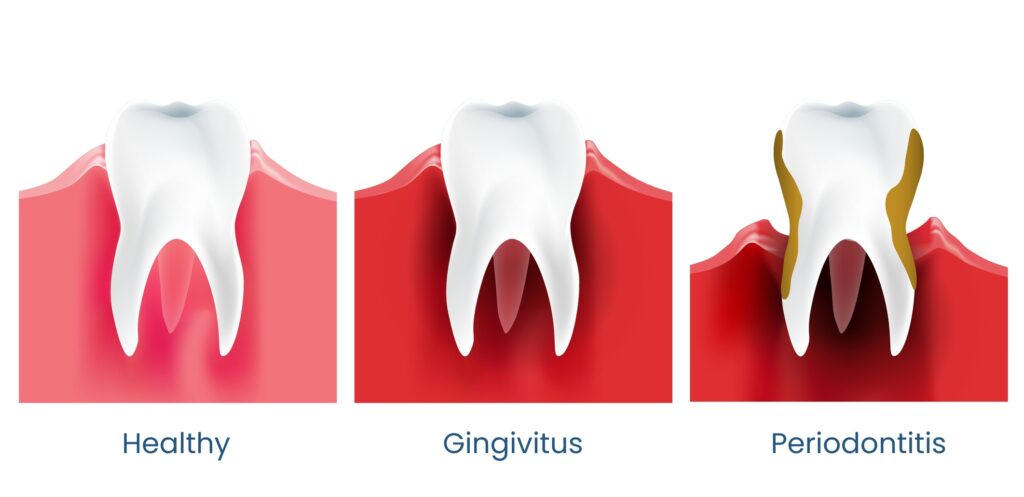
Periodontal diseases range from
simple gum inflammation
(gingivitis) to serious diseases that
result in major damage to the soft
tissue and bone that support the
teeth (periodontitis). In the worst
cases scenario teeth are lost.
Whether your gum disease is
stopped, slowed, or gets worse
depends a great deal on your daily
dental hygiene.
When bacteria remain in contact
with the gums and teeth for
extended periods, they can
become harmful. This bacteria, in
the form of plaque and tartar,
causes gum inflammation known as
gingivitis. Symptoms of gingivitis
include red, swollen gums that may
bleed easily.
Gingivitis is a mild form of gum
disease that is typically reversible
with consistent brushing, flossing,
and regular professional cleanings
by a dentist or hygienist. Unlike
more severe forms of gum disease,
gingivitis does not result in the loss
of bone or tissue around the teeth.
When gingivitis is not treated, it
can advance to periodontitis
(inflammation around the tooth).
In periodontitis, gums pull away
from the teeth and form spaces,
called pockets that become
infected. The body’s immune
system fights the bacteria as the
plaque spreads and grows below
the gum line. Bacterial toxins and
the bodVs natural response to
infection start to break down the
bone and connective tissue that
holds teeth in place. If not treated,
the bones, gums, and tissue that
support the teeth are destroyed.
The main goal of treatment is to
control the infection. The number
and types of treatment will vary,
depending on the extent of the
gum disease. Any type of
treatment requires that the patient
keeps up good daily care at home.
The doctor may also suggest
changing certain behaviors, such as
stop smoking, as a way to improve
treatment outcome.
A dentist, periodontist, or dental
hygienist performs a deep cleaning
known as scaling and root planning
to remove bacteria. Scaling
involves removing tartar from
above and below the gum line,
while root planning smooths rough
spots on the tooth root to
eliminate plaque and tartar.
In more severe cases, surgical
procedures may be combined with
antibiotics or antimicrobial
treatments. If treatment is delayed,
dental extractions may be
necessary to prevent further bone
loss.